
Organise Fitness Coaching Without Spreadsheets
Spreadsheets work at the start. Then they slowly turn into a problem. Tabs increase. Data gets scattered. You spend more time managing sheets than coaching clients. The issue is not spreadsheets themselves. It is trying to run an entire coaching business through them.
Why Spreadsheets Stop Working for Coaches
Spreadsheets are not built for daily coaching operations.
Data is spread across multiple sheets and tabs.
Hard to track client updates in real time.
No clear view of the client's progress status.
Manual updates are required for every change.
Easy to miss important client information.
This leads to confusion and delays in decision-making.
What Organised Coaching Actually Looks Like
An organised setup is not complicated. It is structured.
Each client has one clear data profile.
All updates are stored in one central place.
Progress, payments, and notes are linked together.
Communication is tied to client activity.
No need to switch between multiple tools.
A CRM for fitness coaches helps create this clarity.
What to Replace First from Spreadsheets
You do not need to remove everything at once. Start with the most painful parts.
Client list scattered across multiple sheets.
Progress tracking is stored in different tabs.
Notes written without a clear structure.
Payment tracking mixed with other data.
Follow-ups are managed manually in sheets.
These areas create the most friction.
Spreadsheet vs Structured Setup
The difference becomes clear when you compare daily usage.
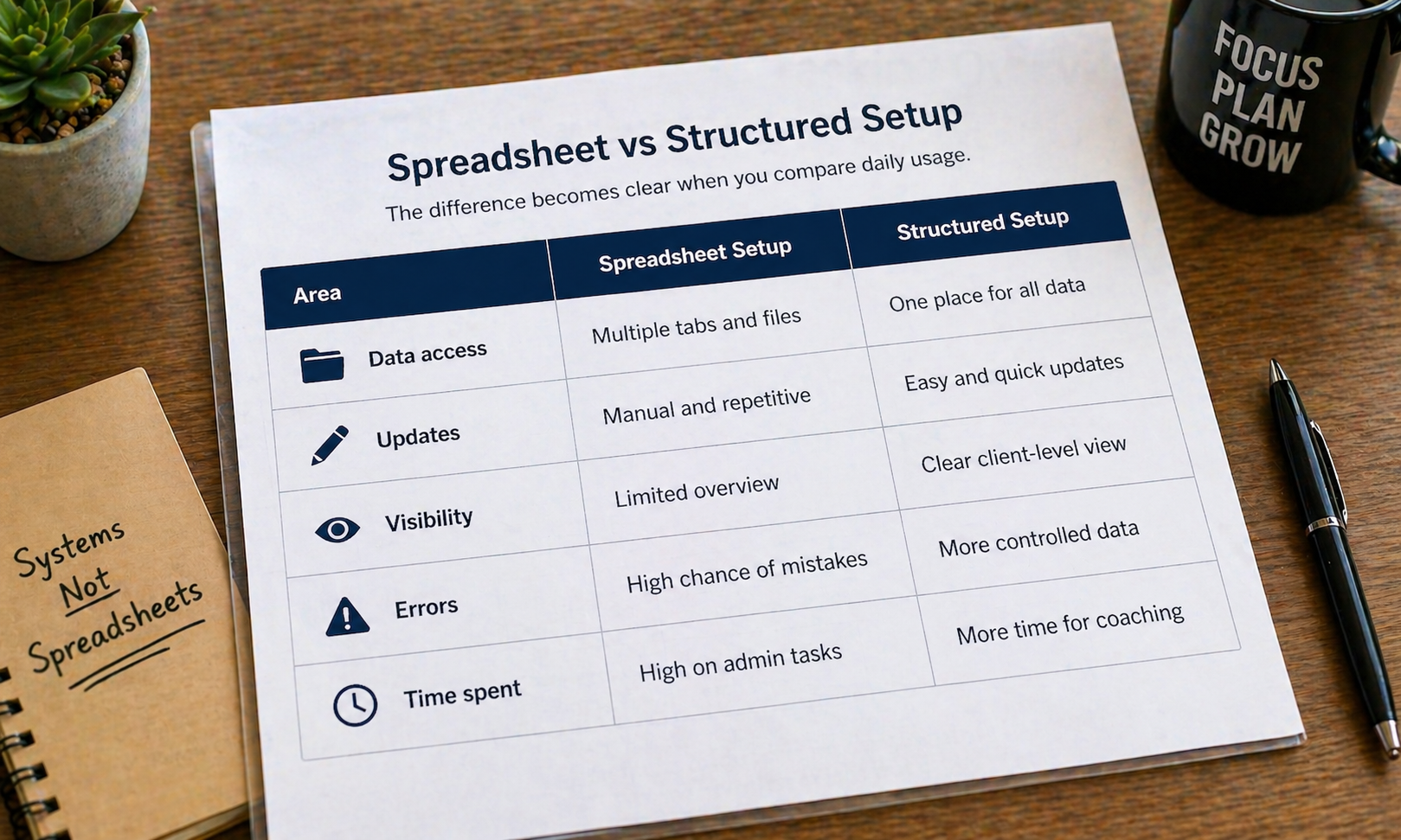
Area | Spreadsheet Setup | Structured Setup |
Data access | Multiple tabs and files | One place for all data |
Updates | Manual and repetitive | Easy and quick updates |
Visibility | Limited overview | Clear client-level view |
Errors | High chance of mistakes | More controlled data |
Time spent | High on admin tasks | More time for coaching |
How to Transition Without Breaking Workflow
Moving away from spreadsheets should be gradual.
Start with active clients first.
Move one data type at a time.
Keep structure consistent for all clients.
Avoid using multiple systems together.
Review and adjust as you move forward.
A CRM for fitness coaches can help centralise everything without confusion.
How a CRM Supports an Organisation
A CRM for fitness coaches is not just storage. It connects your workflow.
Keeps all client data in one place.
Links progress, payments, and communication.
Tracks updates without manual entry errors.
Makes client history easy to access.
Reduces dependency on scattered sheets.
It replaces chaos with structure.
Signs You Need to Move Away from Spreadsheets
If these feel familiar, it is time to change.
You search for client data frequently.
You forget to update the sheets regularly.
You manage too many tabs daily.
You miss updates or follow-ups.
You feel overwhelmed by simple tasks.
These are signs of a broken system, not a lack of effort.
When your data is organised, your time goes back to coaching instead of managing sheets.
Frequently Asked Questions
Why are spreadsheets not enough for fitness coaching?
They are not built for real-time updates, client tracking, or managing multiple workflows in one place.
Can I still use spreadsheets for some tasks?
Yes. They can be useful for basic data, but not for managing your entire coaching business.
Is a CRM necessary for an organisation?
Not always at the start, but a CRM for fitness coaches becomes useful as your client base grows.
How long does it take to move away from spreadsheets?
It depends on your setup, but a gradual shift over a few weeks works best.
Related Posts
Manage Fitness Plans for Multiple Clients Efficiently
Learn how to create and manage customized fitness plans for multiple clients using simple systems, tools, and CRM workflows that save time and improve results.

Build a Referral System for Fitness Coaches
Create a referral system for fitness coaching that drives consistent client growth through structured asks, simple rewards, and clear tracking without guesswork